Visit Tunis, Tunisia
Mediterranean capital, UNESCO medina, cliffside village views.
Tunis is Tunisia's capital and the easiest entry point to the country — a Mediterranean city of 2.4 million combining a UNESCO-listed medina, the Bardo Museum's world-class Roman mosaics, the ruins of ancient Carthage, and the blue-and-white cliff village of Sidi Bou Said. Two to three nights covers the essentials.
- Fly into Tunis–Carthage (TUN), a 20-minute taxi from the medina.
- Base yourself in La Marsa or Sidi Bou Said for sea + quiet; the medina for atmosphere.
- Don't miss the Bardo Museum — the largest Roman mosaic collection in the world.
- Carthage is reachable in 25 minutes by the TGM light-rail along the coast.
- April–June and September–November have the best weather; July–August are very hot.
- Region
- Greater Tunis
- Airport
- Tunis–Carthage (TUN)
- Best time
- April–June and September–November
- Stay
- 2–3 nights
Overview of Tunis
Tunis is the practical and cultural starting point for almost every trip to Tunisia. International flights land at Tunis–Carthage (TUN), the country's main airport, just 8 km from the city centre. From here you can reach the medina, Carthage, Sidi Bou Said and the beach suburbs of La Marsa and Gammarth in under 30 minutes.
The old city — the Medina of Tunis — has been a UNESCO World Heritage Site since 1979. Inside its walls are more than 700 monuments: the Zitouna Mosque, Ottoman palaces turned into riad-style hotels, covered souks selling chechia hats, silver, perfume, and food. North of the medina, the modern Ville Nouvelle stretches along the colonial-era Avenue Habib Bourguiba with cafés, the cathedral, and the iconic clock tower.
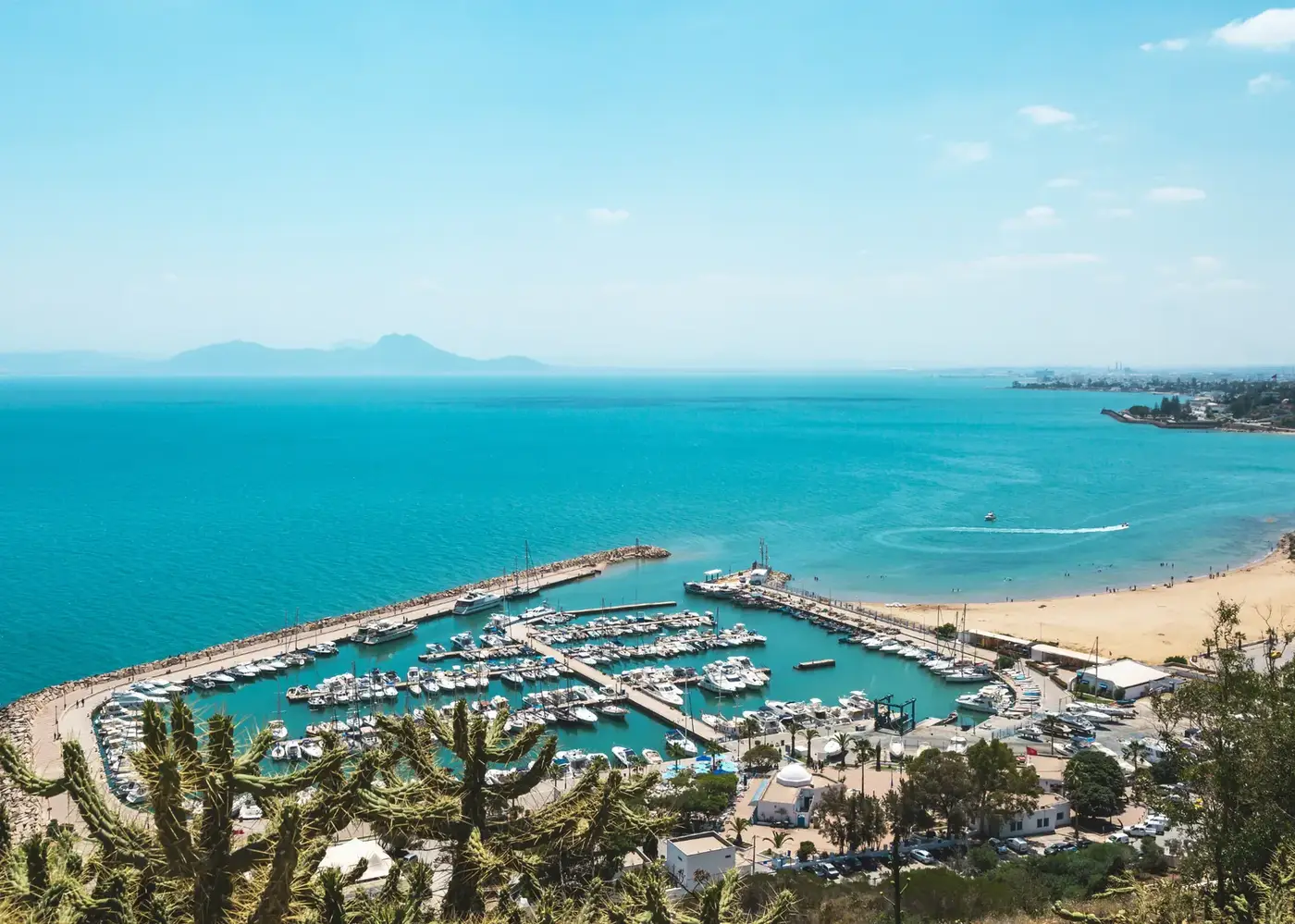
Beyond the city, the coastal suburbs are part of any visit. Carthage — the Phoenician then Roman capital that once rivalled Rome — is reached in 25 minutes on the TGM light-rail. The next stop, Sidi Bou Said, is the famously photogenic clifftop village of whitewashed houses with cobalt-blue doors and bougainvillea, perched 130 m above the sea.
Top attractions in Tunis
- Medina of Tunis (UNESCO)
700+ monuments, 9th-century Zitouna Mosque, Tourbet El Bey, covered souks. Best in the morning before the heat.
- Bardo National Museum
Largest collection of Roman mosaics in the world, housed in a 13th-century Hafsid palace. Allow 2 hours minimum.
- Carthage archaeological site
Antonine Baths, Punic Ports, Byrsa Hill, Roman theatre — eight UNESCO-listed sites spread across the coastal suburb.
- Sidi Bou Said
Whitewashed cliff village above the Gulf of Tunis. Café des Délices and Café des Nattes at sunset are classic.
- Avenue Habib Bourguiba
The 'Champs-Élysées of Tunis' — colonial-era boulevard with cafés, the cathedral, the theatre and the clock tower.
Best things to do in Tunis
- Hammam visit
Try Hammam Kachachine (medina, men only) or Dar el Jeld's spa hammam (mixed, upscale).
- Bardo + medina day
Bardo in the morning, lunch at Dar el Jeld or Fondouk el Attarine, medina souks in the afternoon.
- TGM coast ride
Single-track light-rail from Tunis Marine to La Marsa via Carthage and Sidi Bou Said — cheap and scenic.
- La Goulette seafood lunch
The port quarter is famous for fish — Le Café Vert and Chez Slah are local institutions.
- Sunset at Sidi Bou Said
Walk down to the small marina or stay at Café Sidi Chabaane for the cliff view.
Best neighbourhoods to stay in Tunis
- La Marsa / Gammarth
Beach suburbs with The Residence, Four Seasons and boutique villas. Best for couples and longer stays.
- Sidi Bou Said
Boutique riads like La Villa Bleue. Quiet evenings, easy TGM ride to Tunis.
- Medina
Restored dar-style hotels (Dar Ben Gacem, Dar El Jeld) in the heart of the old city — atmosphere over convenience.
What to eat in Tunis
- Brik à l'œuf
Crispy filo triangle with a soft-yolk egg and tuna. Order it as a starter anywhere.
- Couscous de poisson
Friday tradition — couscous with grouper or sea bass in saffron broth. Try at Dar el Jeld or Le Café Vert.
- Lablabi
Tunis breakfast: chickpea soup over stale bread, harissa, cumin, capers, soft egg. Around 4–6 TND.
How to get to Tunis
Tunis–Carthage Airport (TUN) is the main hub, served by Tunisair, Air France, Lufthansa, Turkish Airlines, EgyptAir and EU low-cost carriers. Taxi to the city centre is 15–25 TND on the meter (about €5–8). The TGM light-rail runs from Tunis-Marine along the coast to La Marsa every 15 minutes.
Day trips from Tunis
- Carthage + Sidi Bou Said
Classic half-day combo using the TGM. Add La Marsa for lunch.
- Dougga (UNESCO)
Best-preserved Roman city in North Africa, 110 km west — 2-hour drive each way.
- Korbous & Cap Bon
Coastal hot springs and Mediterranean cliffs, 1.5 hours east.
Practical tips
- Most central Tunis attractions accept card; markets and louages are cash-only.
- Friday is the Muslim day of prayer — some restaurants close 12:00–14:00.
- Women should dress modestly inside the medina and mosques (shoulders + knees covered).
Frequently asked questions about visiting Tunis
How many days do I need in Tunis?
Is Tunis safe for tourists?
What's the best area to stay in Tunis?
How do I get from TUN airport to the city?
Plan your trip to Tunis
- The Residence Tunis5★ palace by the sea
- Four Seasons TunisModern luxury, Gammarth
- Medinas & souks of TunisiaTunis is the UNESCO medina capital.
- Roman ruins in TunisiaCarthage on the doorstep.
- Boutique riads in Tunisia
- La Tunisie pour les voyageurs français : guide complet 2026Le guide francophone d'eTunisie pour les voyageurs français.
- Tunisia Travel Guide 2026: Everything You Need to KnowThe full Tunisia primer — written by editors based in Tunis.
- Visit Djerba514 km² Mediterranean island, year-round sun, the longest beach in Tunisia.
- Visit HammametTunisia's original beach resort — long sandy bay, jasmine-scented medina, world-class spas.