etunisie
etunisie
World currency symbols overlaid on live exchange-rate ticker
Plan Your Trip

Currency: the Tunisian dinar (TND)

The Tunisian dinar is a closed currency — you can't get it before you arrive and you can't take it out. That sounds restrictive but it's straightforward in practice: change a small amount on arrival, use ATMs as you go, keep a stash of cash for the souks. Here's how it actually works.

TND
Tunisian Dinar
1 TND ≈ €0.30
Indicative rate
1000
Millimes per dinar
Cash
King outside resorts

Convert money — live tool

Use the converter below to check what your money is worth in Tunisian dinar (and back). Rates update on demand from a free mid-market feed; the actual rate at a Tunisian bank or bureau is usually within 1–3% of these values.
Reference rates
29.5
1 TND = 0.295 EURFull converter
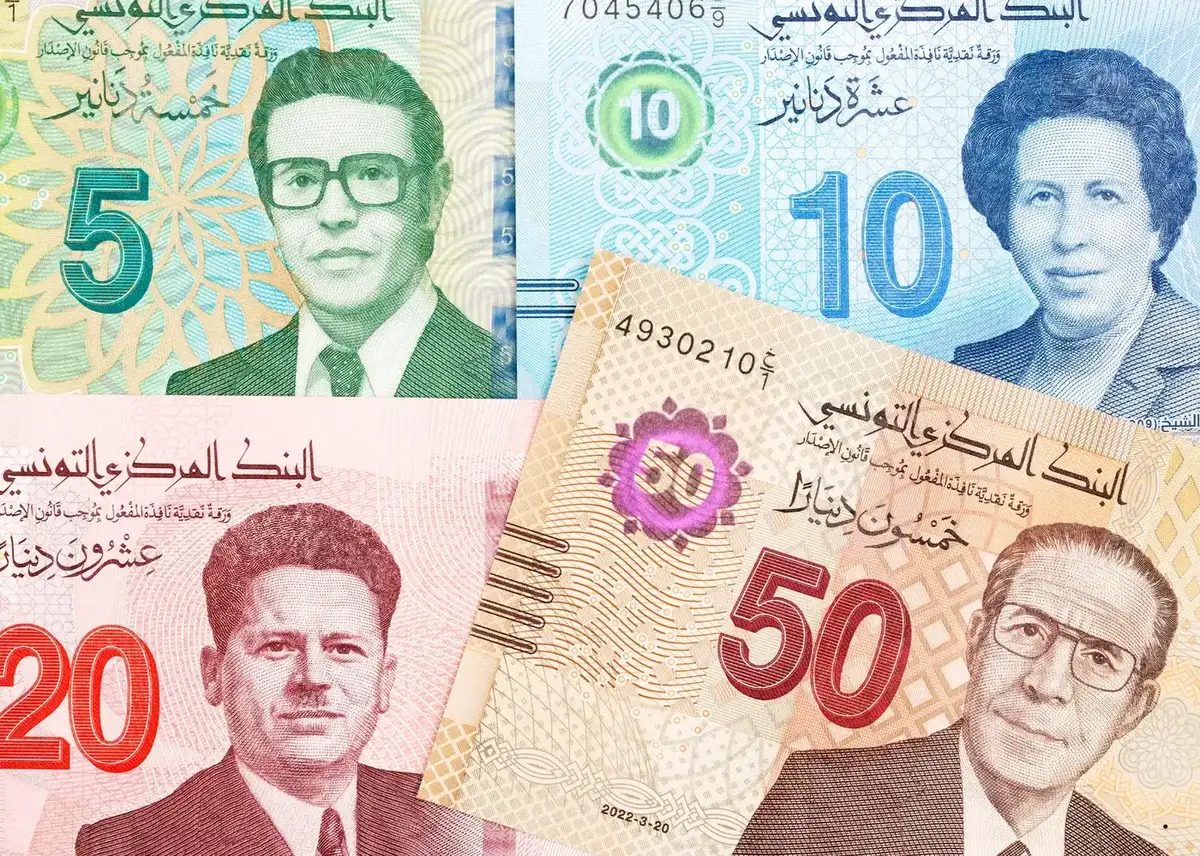
Tunisian dinar banknotes — a closed currency

Closed currency — what it means

Unlike the euro or the dollar, the dinar can't be bought or sold outside Tunisia. You cannot pre-order it from your bank. You cannot take more than 100 TND in cash across the border on exit. Any unused dinars must be exchanged back to a foreign currency at the airport on departure (you'll need your original exchange receipt). Don't worry about this in advance — change €100–€200 on arrival at the airport bureau, and use ATMs as you go.

Where to change money

Airport bureaux de change: open during all flight arrivals. Rates are official, fair and slightly worse than in town (roughly 1–2% spread). Good for the first €100–€200. Bank branches: best rates. Bring your passport. Open Mon–Fri, mornings and late-afternoons (closed for a long lunch). The big chains are BIAT, BH Bank, Attijari Bank, UBCI and Amen Bank. Hotel reception: convenient but the worst rates — typically 5–7% below the bank rate. Use only as a last resort. Street exchangers: illegal and not worth the small saving.
ATM and card payments in Tunisia

ATMs and cards

ATMs are everywhere in cities, resort areas and even smaller towns — at banks, in shopping centres, at airports. Most accept Visa, Mastercard, Maestro and Cirrus. Daily withdrawal limit is typically 400–600 TND per transaction; you can usually do two transactions per day. Fees: most Tunisian ATMs charge a flat 5–8 TND fee for foreign cards on top of your home bank's fee. To minimise: withdraw the maximum, carry it carefully. Card acceptance: widespread in 4-star+ hotels, mid-range and upscale restaurants, supermarkets, airline offices and major shops. Rare to non-existent in souks, taxis (except Bolt), small cafés, louages and most desert camps. Carry cash for these.

Tipping

Tipping is appreciated but not aggressive. Standard guidelines: Restaurants: 5–10% if service was good and not already included. Taxis: round up to the nearest dinar; no need to tip more. Hotel porters: 1–2 TND per bag. Housekeeping: 2–5 TND per day. Guides and drivers: 10–20 TND per day per person for a multi-day tour. Hammam masseuse: 10–20 TND for the full ritual. Boat captain on a half-day cruise: 5–10 TND per person. Keep small notes (5, 10, 20 TND) handy for tipping.

Cost of living for travellers

A few useful benchmarks: Espresso: 2–3 TND. Sit-down lunch (3 courses + drink): 25–50 TND. 3-course dinner at a good restaurant: 60–120 TND/person. Bolt taxi across town: 5–15 TND. All-inclusive 4-star, low season: 200–350 TND/person/night. All-inclusive 5-star, peak season: 500–900 TND/person/night. Kairouan carpet (small): 200–600 TND. Litre of bottled water at a kiosk: 1.5–2 TND; at a restaurant: 3–5 TND. At today's rate (~3.4 TND to €1), Tunisia remains one of the best-value Mediterranean destinations.

Ready to plan your Tunisia trip?

Build a custom 3, 7 or 14-day itinerary in 60 seconds with our AI Trip Planner.