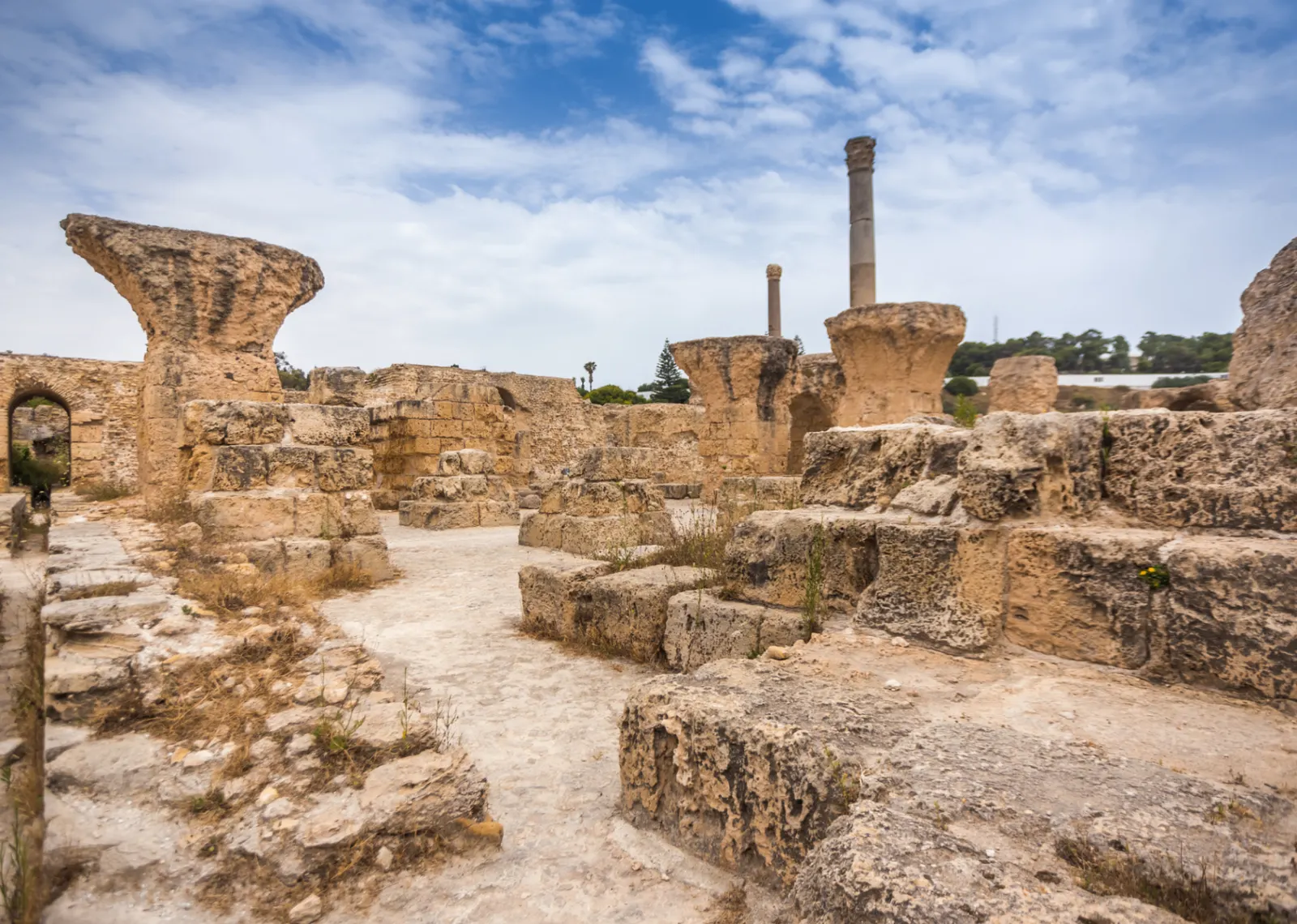
Visit Carthage, Tunisia
The Phoenician then Roman capital that once rivalled Rome — UNESCO ruins above the Gulf of Tunis.
Carthage is the coastal suburb of Tunis built on top of the ancient Phoenician and Roman capital that rivalled Rome — and was destroyed by it in 146 BCE. The eight UNESCO-listed archaeological sites are spread across the modern residential neighbourhood and can be combined into a half-day visit using the TGM light-rail.
- 5 km from Tunis–Carthage airport, 25 minutes from central Tunis by TGM light-rail.
- Eight separate sites covered by a single combined ticket — Antonine Baths, Byrsa Hill, Punic ports, theatre, museums.
- Most visited as a half-day from Tunis, paired with Sidi Bou Said.
- Wear closed shoes, bring water — the sites are open-air, hot in summer.
- The Carthage National Museum on Byrsa Hill is the best single anchor for the history.
- Region
- Greater Tunis
- Airport
- Tunis–Carthage (TUN) — 5 km
- Best time
- April–June, September–November
- Stay
- Day trip from Tunis (or 1 night in Sidi Bou Said)
Overview of Carthage
Carthage was founded by Phoenician traders from Tyre around 814 BCE and grew into the dominant power of the western Mediterranean — a maritime empire that fought three wars with Rome (the Punic Wars) and produced Hannibal Barca, who crossed the Alps with elephants. Rome destroyed it in 146 BCE, salted the earth, and a century later rebuilt it as the Roman capital of Africa Proconsularis — for several centuries the second-largest city in the western empire.
Modern Carthage is a quiet residential suburb on the Gulf of Tunis, north-east of the capital. The archaeological remains are scattered across this neighbourhood — not concentrated in one site like Pompeii or Ephesus — and need a half-day with a map. The TGM light-rail makes its way through, with stations roughly aligned to the main sites: Carthage Hannibal, Carthage Présidence, Carthage Byrsa, Carthage Salammbô.
The standout monuments are the Antonine Baths — second-largest Roman bath complex outside Rome itself — directly on the seafront, the Byrsa Hill museum on the historic acropolis, and the Punic ports (now twin lagoons) that once sheltered Hannibal's war fleet. The Roman amphitheatre and theatre, the Roman villas and the Magon quarter add depth for a full day.
Top attractions in Carthage
- Antonine Baths
Second-largest Roman bath complex outside Rome — only the foundations remain, but their scale is staggering.
- Byrsa Hill + Carthage National Museum
The ancient acropolis — Punic-era ruins, French cathedral, museum with key finds from the site.
- Punic ports (Salammbô)
Twin circular lagoons that were Hannibal's military harbour. Small interpretive museum.
- Roman theatre
Restored Roman theatre still in use — Carthage Festival every July/August.
- Roman villas quarter
Excavated Roman residential terraces — mosaics, Schola of the Roman Knights.
Best things to do in Carthage
- Carthage + Sidi Bou Said combo
Classic half-day TGM circuit — ruins in the morning, Sidi Bou Said for lunch and the cliff view.
- Carthage Festival (July–August)
Tunisia's biggest summer arts festival uses the Roman theatre — international music acts.
- Cathedral St Louis
On Byrsa Hill — colonial-era church, now Acropolium concert venue.
- Antonine Baths sunset walk
Sea-edge ruins are best in late afternoon light.
- Bardo Museum (Tunis)
Pair Carthage with the Bardo — many Carthage finds are displayed there.
Best neighbourhoods to stay in Carthage
- Sidi Bou Said
Next TGM stop — best overnight base for an early-morning Carthage visit.
- La Marsa / Gammarth
Beach suburb with The Residence and Four Seasons — Carthage is 10 minutes away.
- Tunis centre
Day trip by TGM (25 minutes from Tunis-Marine).
What to eat in Carthage
- Lunch at La Marsa Plaza
Pair Carthage morning with a seafront lunch in La Marsa — Le Carl, Le Golfe, Tchevap.
- Coffee at Café des Délices (Sidi Bou Said)
Post-ruins terrace coffee with the Gulf of Tunis view.
- Au Bon Vieux Temps (Sidi Bou marina)
Sit-down French-Tunisian seafood dinner.
How to get to Carthage
TGM light-rail from Tunis-Marine to Carthage Hannibal takes 22 minutes (1.4 TND). By taxi from central Tunis it's 20–30 TND on the meter. Tunis–Carthage Airport is 5 km from the ruins — 10 minutes by taxi.
Day trips from Carthage
- Sidi Bou Said
5-minute next TGM stop — the blue village.
- Medina + Bardo
Pair morning Carthage with afternoon Bardo Museum in Tunis.
- Dougga (UNESCO)
2 hours west — the best-preserved Roman city in North Africa.
Practical tips
- Buy the multi-site Carthage ticket (~12 TND) at any site — covers all eight sites for one day.
- Start at Byrsa Hill for context (museum + view of the whole layout) before walking down to the other sites.
- Antonine Baths is closed Mondays; check site hours before going.
Frequently asked questions about visiting Carthage
How much time do I need at Carthage?
Are the Carthage ruins worth visiting?
How do I get from Tunis to Carthage?
Can I visit Carthage from Hammamet?
Plan your trip to Carthage
- Roman ruins in Tunisia
- La Tunisie pour les voyageurs français : guide complet 2026Le guide francophone d'eTunisie pour les voyageurs français.
- Tunisia Travel Guide 2026: Everything You Need to KnowThe full Tunisia primer — written by editors based in Tunis.
- Visit TunisMediterranean capital, UNESCO medina, cliffside village views.
- Visit Djerba514 km² Mediterranean island, year-round sun, the longest beach in Tunisia.