etunisie
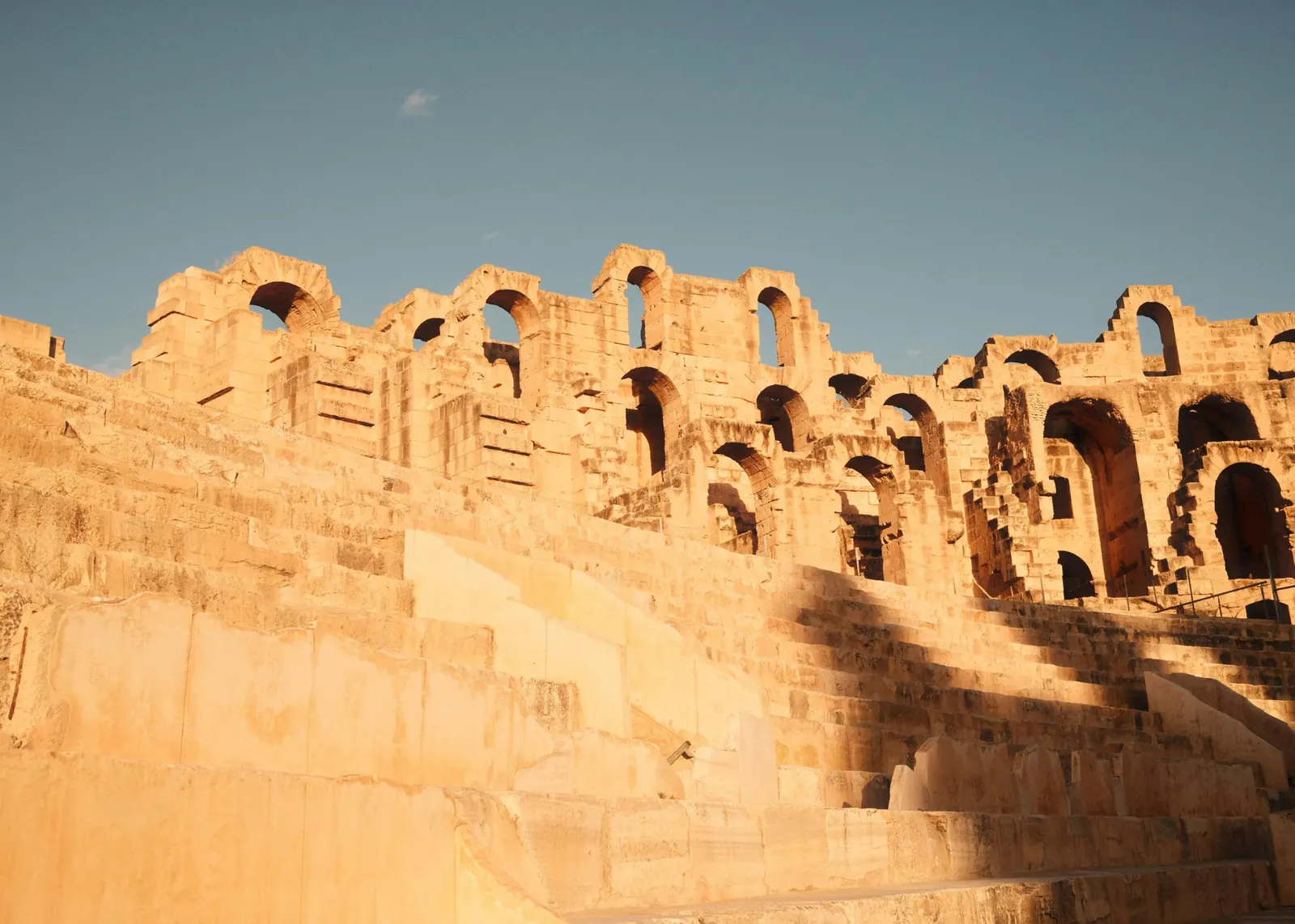
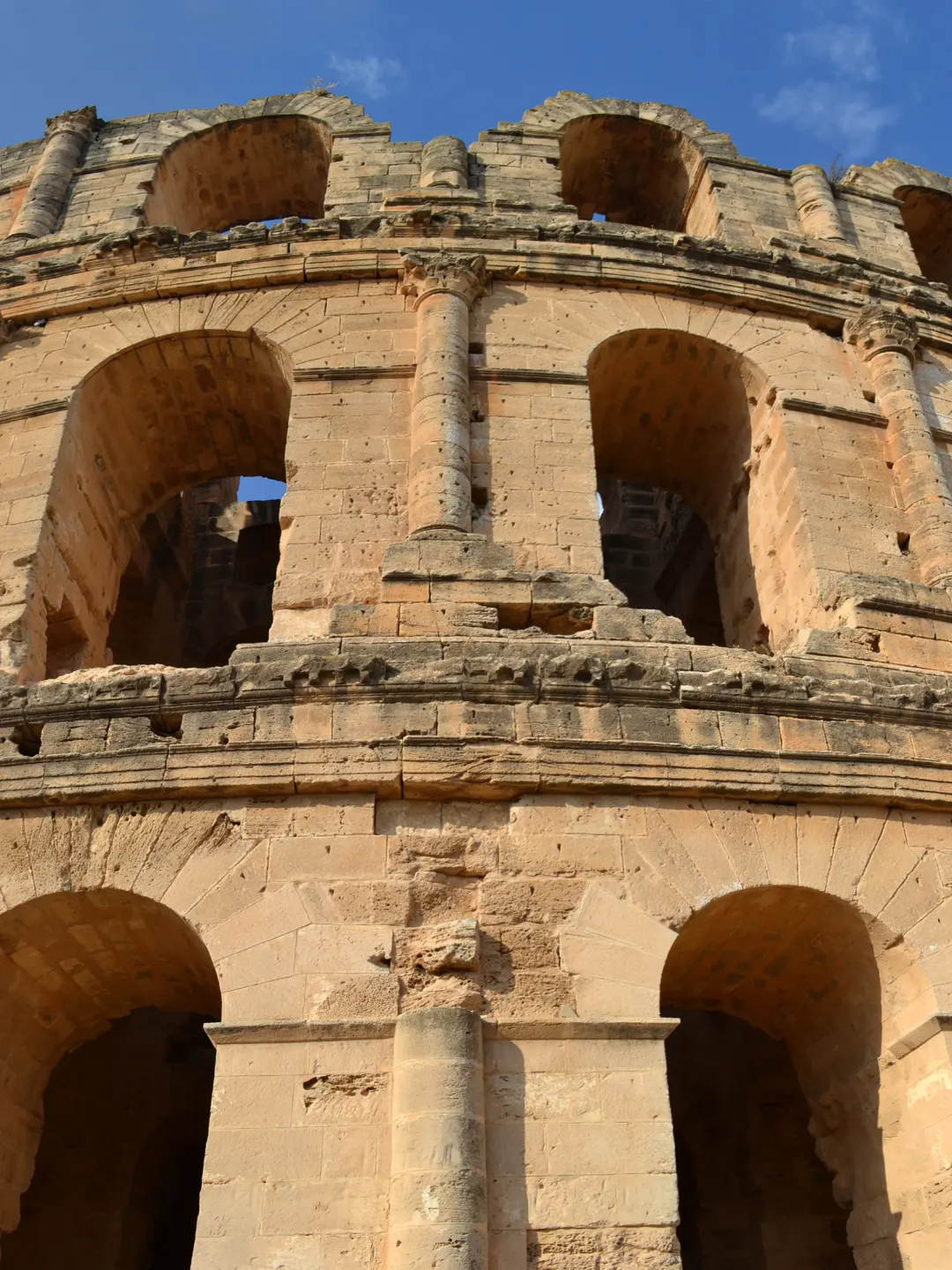
Detail of the El Jem Roman amphitheatre
About Tunisia

Culture & heritage: 3,000 years at the centre of the Mediterranean

Tunisia is a small country with a vast biography. From Hannibal's elephants and Saint Augustine's sermons to the first Arab capital of North Africa, the Andalusian refugees, the Ottoman beys and the birthplace of the Arab Spring — every chapter of Mediterranean history was written, in part, on this soil. Twelve centuries before Paris had a city wall, Carthage was already negotiating treaties with Rome. Here is what that long memory looks like today.

8
UNESCO World Heritage sites
814 BC
Founding of Carthage
3,000+
Years of urban civilisation
9
Civilisations that shaped it

Carthage: the empire that nearly beat Rome

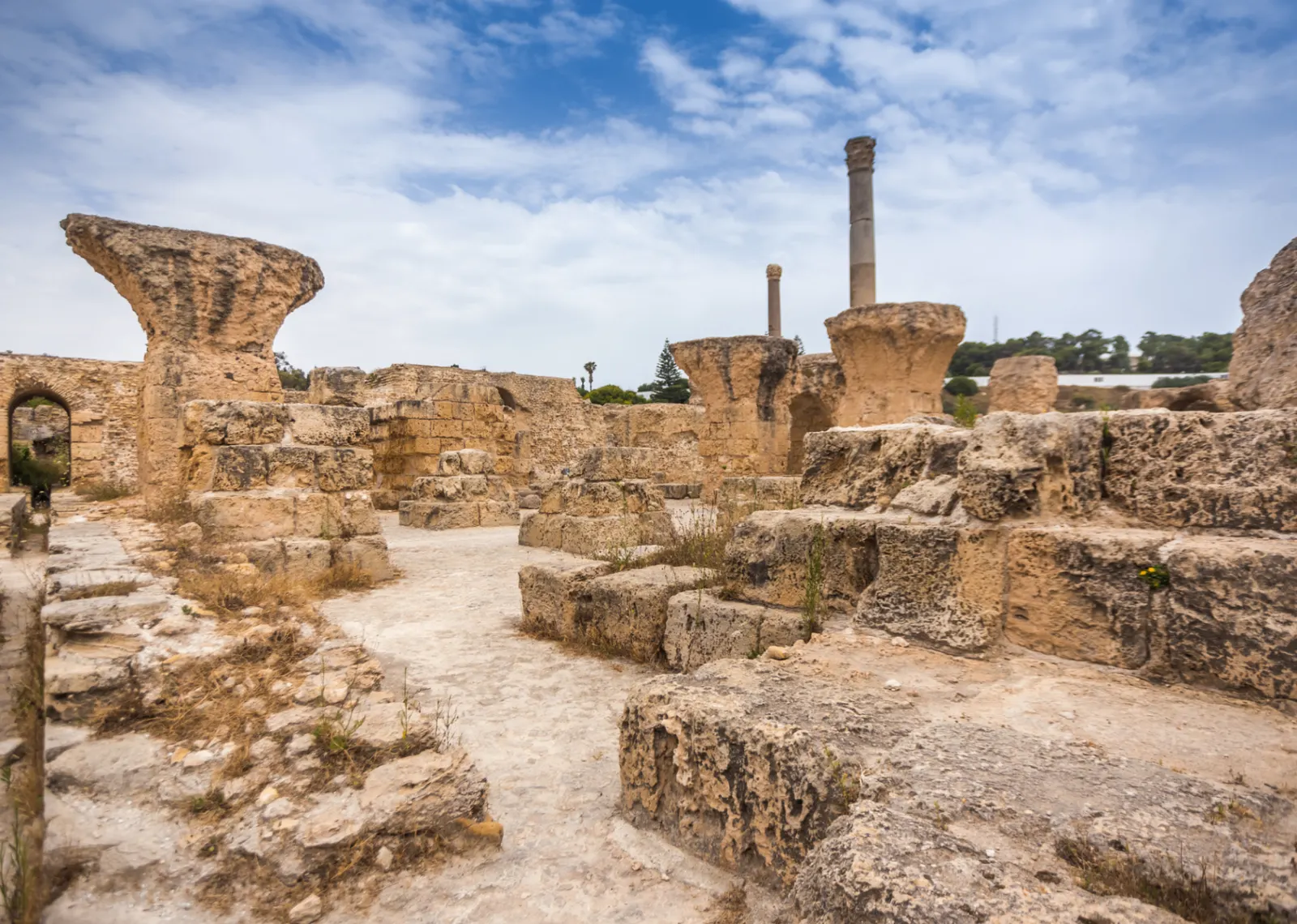
In 814 BC, Phoenician traders from the city of Tyre — in modern Lebanon — sailed west and founded a small trading post on a defensible hill above the bay of Tunis. They called it Qart-ḥadašt, "the new city". Within four centuries, Carthage commanded the western Mediterranean: a maritime empire of 300,000 citizens, with colonies in Sicily, Sardinia, southern Spain and Morocco, a navy of quinqueremes, and a circular military harbour that could hide 220 warships from view. It was the only power Rome ever truly feared. Three Punic Wars (264–146 BC) decided the fate of the western world. In the second, the Carthaginian general Hannibal Barca crossed the Alps with war elephants and spent fifteen years undefeated on Italian soil — annihilating a Roman army of 80,000 at Cannae in a single afternoon, the bloodiest day in Roman military history. Rome eventually won by attrition, sailed to Africa, and in 146 BC burned Carthage so thoroughly that the site was salted, cursed and abandoned. Then, a century later, Rome rebuilt it. Roman Carthage became the second city of the empire after Rome itself — capital of the province of Africa, breadbasket of the Mediterranean, home to the great theologian Saint Augustine, who studied here in the 370s AD. The ruins of the Antonine baths, the third largest in the entire Roman world, still face the sea.
Roman ruins at Sbeitla
El Jem Roman amphitheatre

Roman Africa: the breadbasket of an empire

For five centuries Tunisia — then called Africa Proconsularis — fed Rome. Two-thirds of the wheat consumed in the imperial capital came from Tunisian fields. The wealth this generated built some of the most spectacular Roman cities outside Italy, and most of them are still standing today, often eerily empty of tourists. El Jem, in the central plains, holds the third-largest amphitheatre in the Roman world — a 35,000-seat colosseum that dwarfs the one in Rome's outer suburbs and rivals the original itself. Dougga, set on a hilltop two hours from Tunis, is widely considered the best-preserved Roman small town anywhere in North Africa: a complete Capitoline temple, a theatre cut into the slope, a forum, baths, brothels, and the cobbled lanes still wide enough for a chariot. Sbeitla preserves three temples in a row — a configuration almost unique in the Roman world. Bulla Regia is famous for its underground villas, where wealthy Romans lived a storey beneath ground level to escape the summer heat, with mosaic floors of breathtaking quality still in place. The Bardo Museum in Tunis holds the world's finest collection of Roman mosaics — over 4 hectares of floors and walls lifted from villas across the country, including Virgil being inspired by his muses, the only known portrait of the poet from antiquity.

The Arab conquest and Kairouan, mother of Maghreb cities

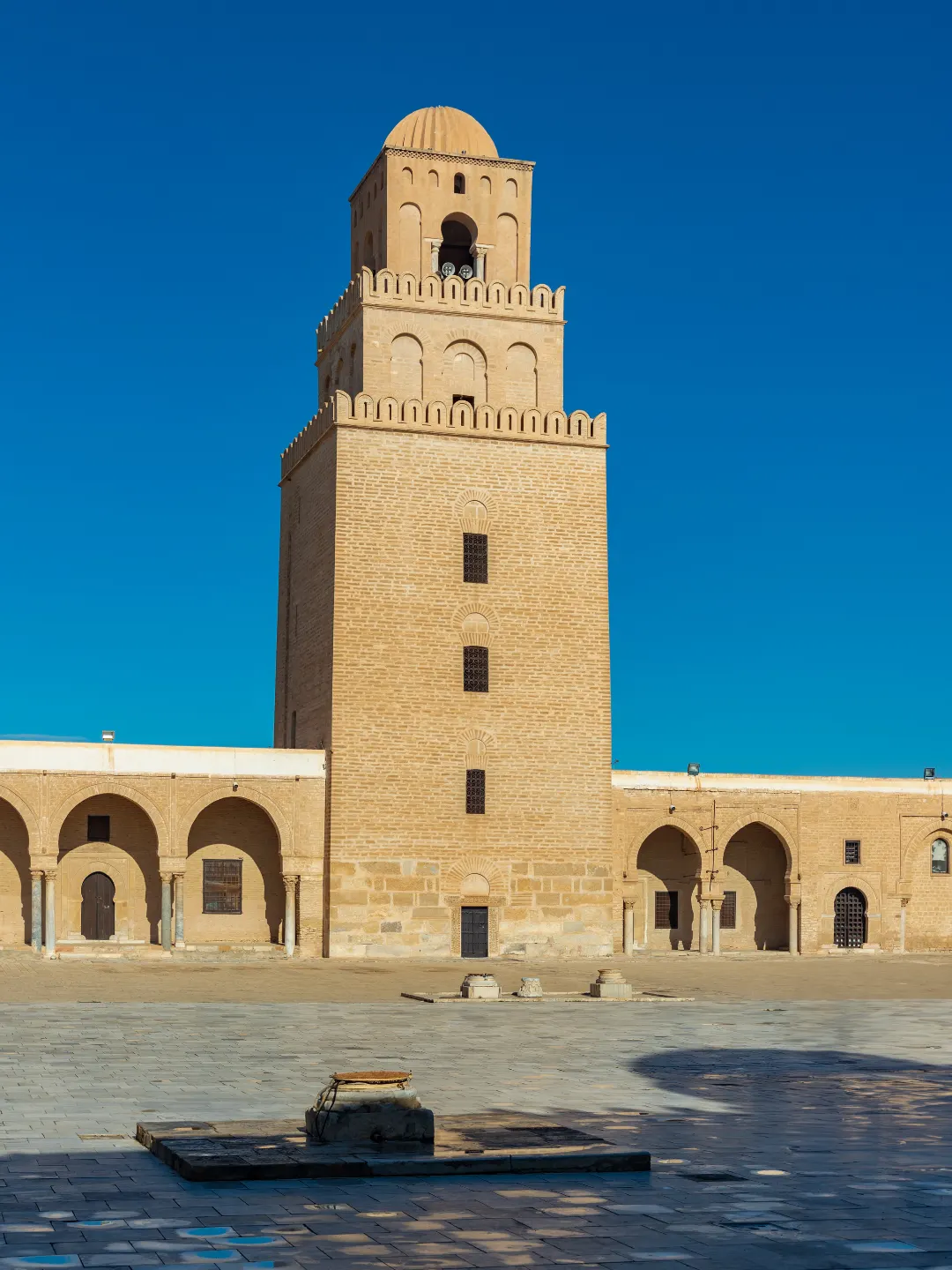
In 670 AD, the Arab general Uqba ibn Nafi rode out of the Egyptian desert and founded the city of Kairouan in the Tunisian interior. It was the first Arab city in North Africa and, for three centuries, the political, religious and intellectual capital of the entire Maghreb — from Libya to the Atlantic. Everything that followed in Islamic North Africa, in Andalusia, even in West Africa, passed through Kairouan first. Its Great Mosque is one of the oldest in the Islamic world. The vast marble courtyard, the forest of recycled Roman and Byzantine columns (no two alike), the squat 9th-century minaret considered the prototype for every minaret in the western Muslim world — it is a working monument, not a museum, and the model that Cordoba and Seville later imitated. Tradition holds that seven pilgrimages to Kairouan equal one to Mecca, making it the fourth holiest city in Islam. Kairouan was also the cradle of Maliki jurisprudence, one of the four schools of Sunni law — taught here in the 9th century by Sahnun, whose Mudawwana is still a foundational legal text from Morocco to Indonesia. Walk into the Mosque of the Three Doors, founded in 866 AD, and you stand in front of the oldest sculpted facade in the Muslim world.
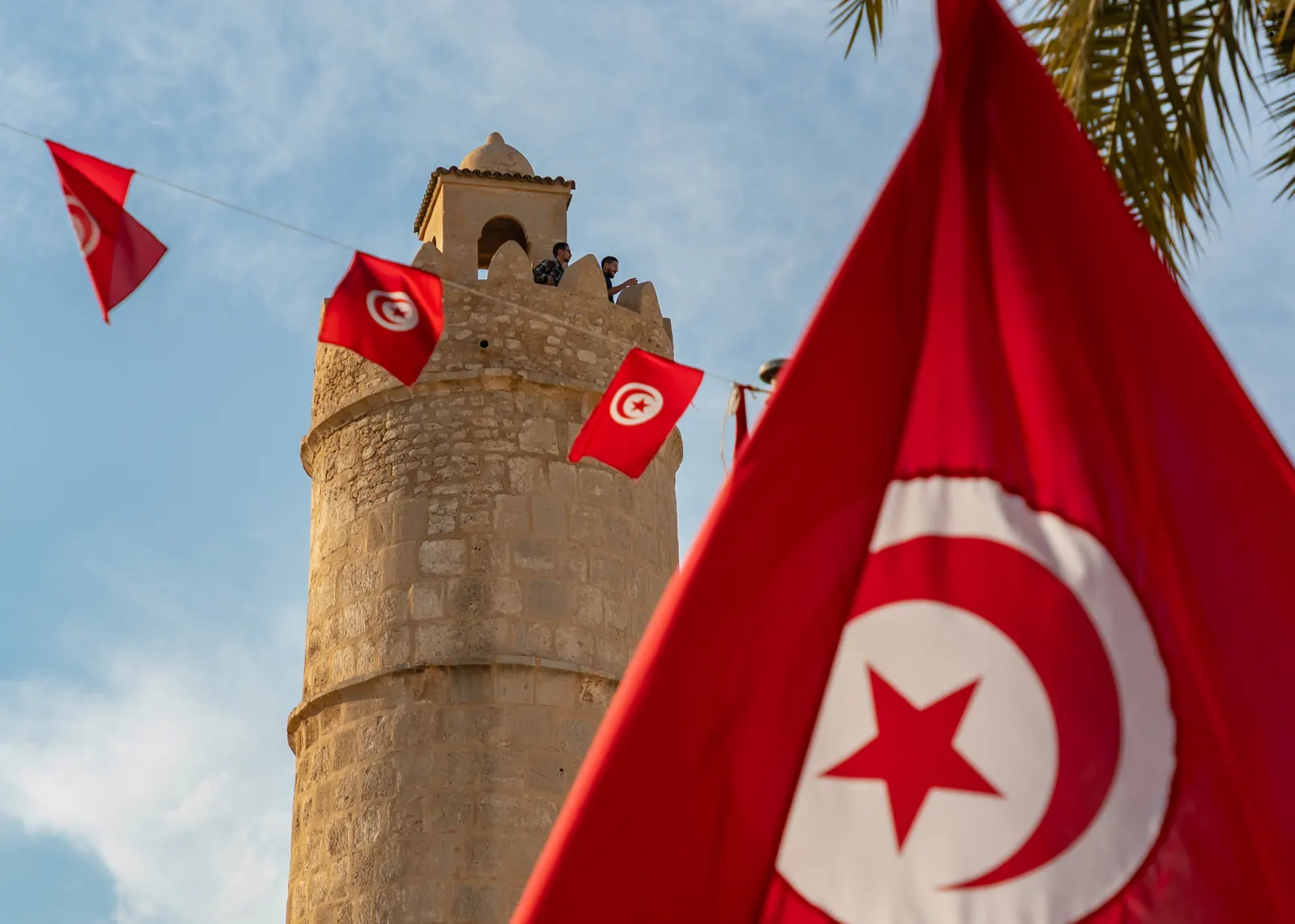
Tunisian flag above the rooftops of Kairouan
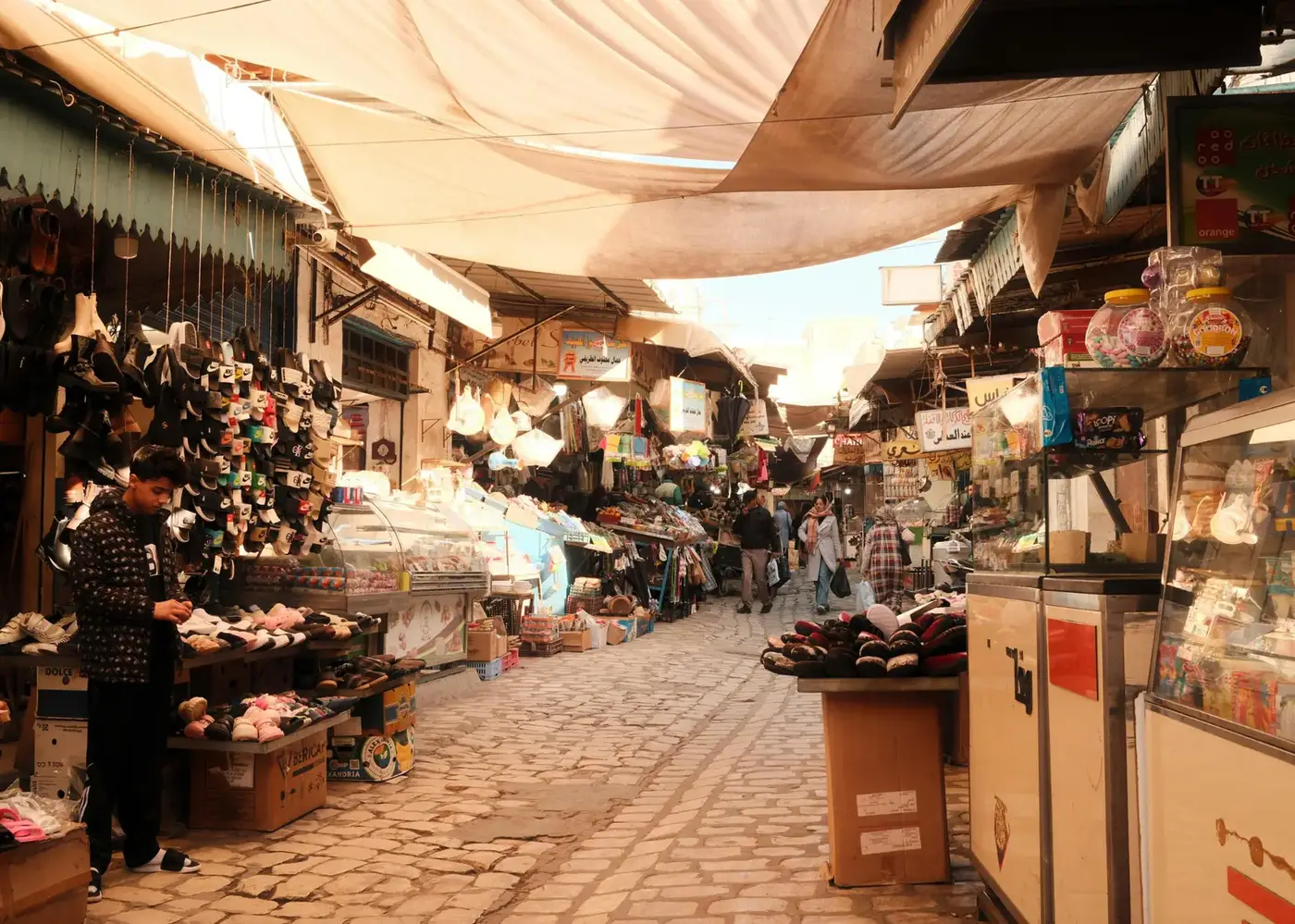
Tunisian medina souk

The medinas: 1,200 years of urban life, still working

When the Arabs founded their cities they invented an urban form that defined the Mediterranean south for a millennium: the medina. A walled old town of narrow shaded lanes, courtyard houses turned inward against the heat, mosques marking each quarter, a covered souk at the centre with each trade given its own street — perfumers, copper-beaters, silk weavers, bookbinders, sandal-makers — and gates that closed at sunset. Four Tunisian medinas are inscribed on the UNESCO World Heritage list: Tunis, Sousse, Sfax and Kairouan. The Tunis medina alone has 700 listed monuments — palaces, madrasas, mausoleums, fountains, hammams — packed into 280 hectares. What makes it remarkable is not preservation but continuity: these are living neighbourhoods, not museum quarters. Butchers, perfumers, copper-beaters and sandal-makers still work in the same streets their grandfathers worked. The Tunis souk has been the city's commercial heart since 698 AD. Children walk to school past 13th-century portals. Spend an afternoon getting lost in one. Have mint tea on a rooftop overlooking the Zaytuna Mosque. Watch a craftsman engrave a brass tray the same way it has been done for 800 years. This is the single best thing you can do in Tunisia.

Andalusia in exile: Sidi Bou Said and the Moorish legacy

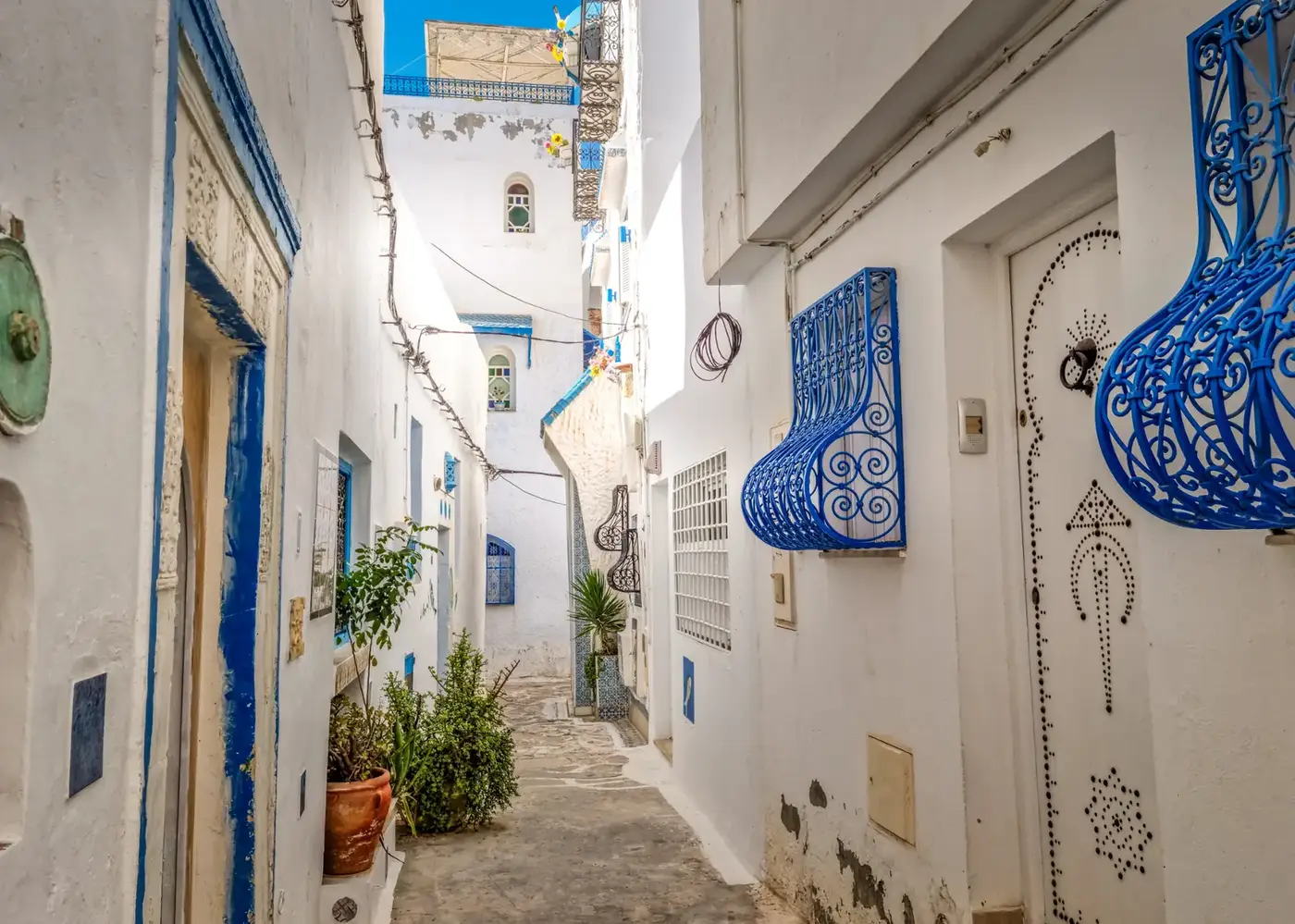
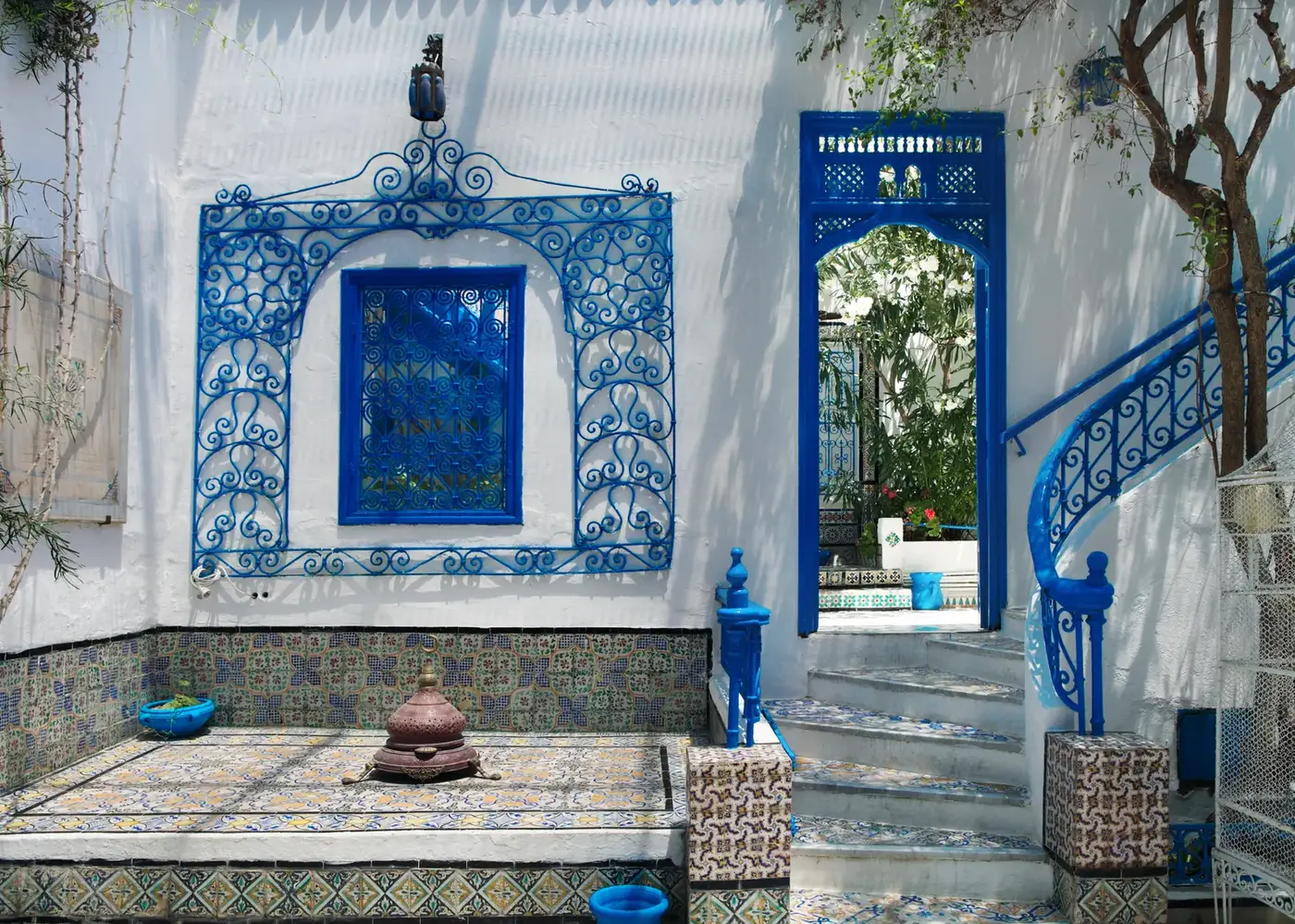
When the Catholic kings completed the Reconquista and expelled the Muslims of Spain in 1492, and again the Moriscos in 1609, hundreds of thousands fled across the Mediterranean. The largest single wave landed in Tunisia. They were not refugees in any modern sense — they were a sophisticated urban population carrying centuries of Andalusian science, agriculture, architecture, music and cuisine, and the Tunisian state welcomed them as builders. They founded entire towns along the Medjerda valley — Testour, Sloughia, Grombalia, Soliman — laid out on a Spanish grid, with churches turned into mosques whose minarets still carry Christian-style square towers. They brought citrus orchards and the technique of irrigated gardens. They brought the chechia, the soft red felt cap that became Tunisia's national headgear. And they brought the malouf, a courtly Andalusian classical music descended from medieval Granada, still performed today by orchestras across the country. The most photographed expression of all this is the cliff-top village of Sidi Bou Said, two hammered-blue and whitewashed kilometres above the bay of Carthage. Cobbled lanes, studded blue doors with thousands of black nails forming geometric patterns, jasmine spilling from courtyards, café terraces watching the Mediterranean turn pink at dusk. The painter Paul Klee came here in 1914 and wrote that colour had finally taken possession of him.
Andalusian-style ceramic tiles in Sidi Bou Said
Christian basilica ruins at Sbeitla

Berbers, Jews and the layered Tunisia

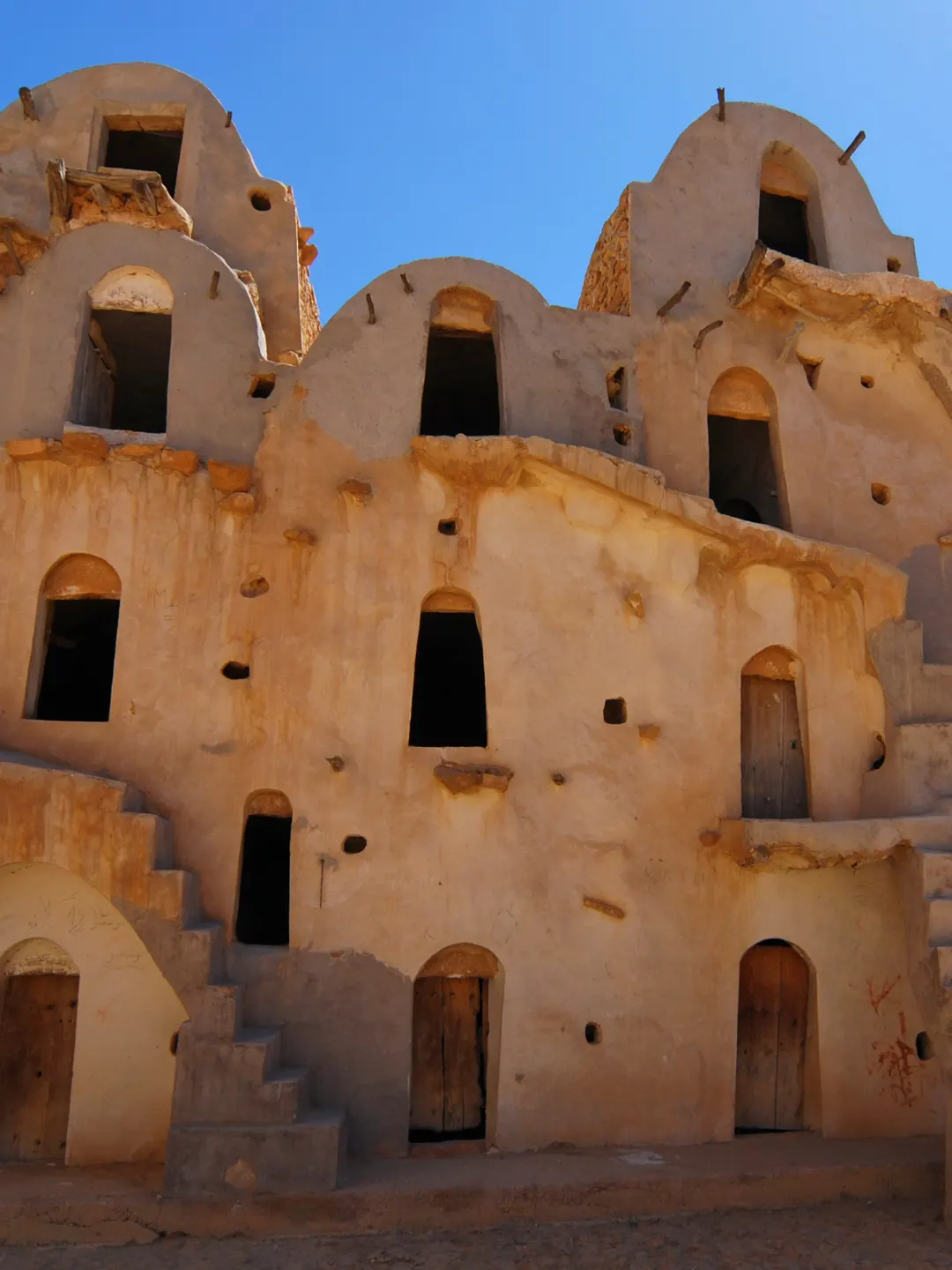
Long before Phoenicians, Romans or Arabs, this land belonged to the Amazigh — the Berbers, North Africa's indigenous people. Their language, traditions and silver jewellery are still alive in the south, in the troglodyte villages of Matmata where families have lived in pit-houses carved into the earth for over a thousand years (and where George Lucas filmed Luke Skywalker's home), in the cliff-top granaries of Chenini and Douiret, and on the island of Djerba, whose calm has sheltered minorities for two and a half millennia. Djerba is also home to one of the oldest continuous Jewish communities in the world. The El Ghriba synagogue, on the southern edge of the island, claims a foundation date of 586 BC — a stone from the destroyed First Temple of Solomon is said to be built into its walls. Every spring, on the festival of Lag BaOmer, Jews from Tunisia, France, Israel and beyond travel here for one of the most important pilgrimages in North African Judaism. Until the mid-twentieth century Tunisia had over 100,000 Jewish citizens; the community is small today but active, and the synagogues of Tunis, Sousse and Djerba still hold services. Tunisia was also home to powerful Christian centres in late antiquity. Saint Augustine, Saint Cyprian and Tertullian — three of the founding figures of Western Christian theology — were all North African, and the early church councils of Carthage shaped Christianity itself. The pluralism of modern Tunisia is not a recent project. It is a 3,000-year inheritance.

Tunisian food: a Mediterranean kitchen with a fire under it

Tunisian cooking is the most distinctive cuisine in North Africa and one of the most underrated in the Mediterranean. It rests on three pillars: olive oil (Tunisia is the world's third-largest producer and supplies a remarkable share of Italy's premium oil), the daily catch from 1,300 km of coastline, and harissa — a fiery paste of sun-dried red chillies, garlic, caraway and coriander that earned UNESCO Intangible Heritage status in 2022. Dishes worth crossing a country for: brik à l'œuf (a paper-thin pastry triangle wrapped around a runny egg, tuna and capers, deep-fried in seconds — the test of a good Tunisian cook is finishing it without dripping yolk on your shirt); couscous au poisson (Friday lunch on the coast — fresh grouper or sea bass on hand-rolled semolina with a saffron broth); ojja merguez (eggs poached in spiced tomato with lamb sausage, eaten directly from the pan with bread); chorba frik (a winter soup of cracked green wheat and lamb that breaks every Ramadan fast); and mloukhia (a slow-cooked dark green stew so beloved it sometimes serves as a marriage test). For sweets: makroudh from Kairouan (a date-stuffed semolina diamond fried and dipped in honey), bambalouni from Sidi Bou Said (warm doughnuts dusted in sugar, eaten on the cliff), and dates from Tozeur — the Deglet Nour, "finger of light", said by locals to be the finest in the world.
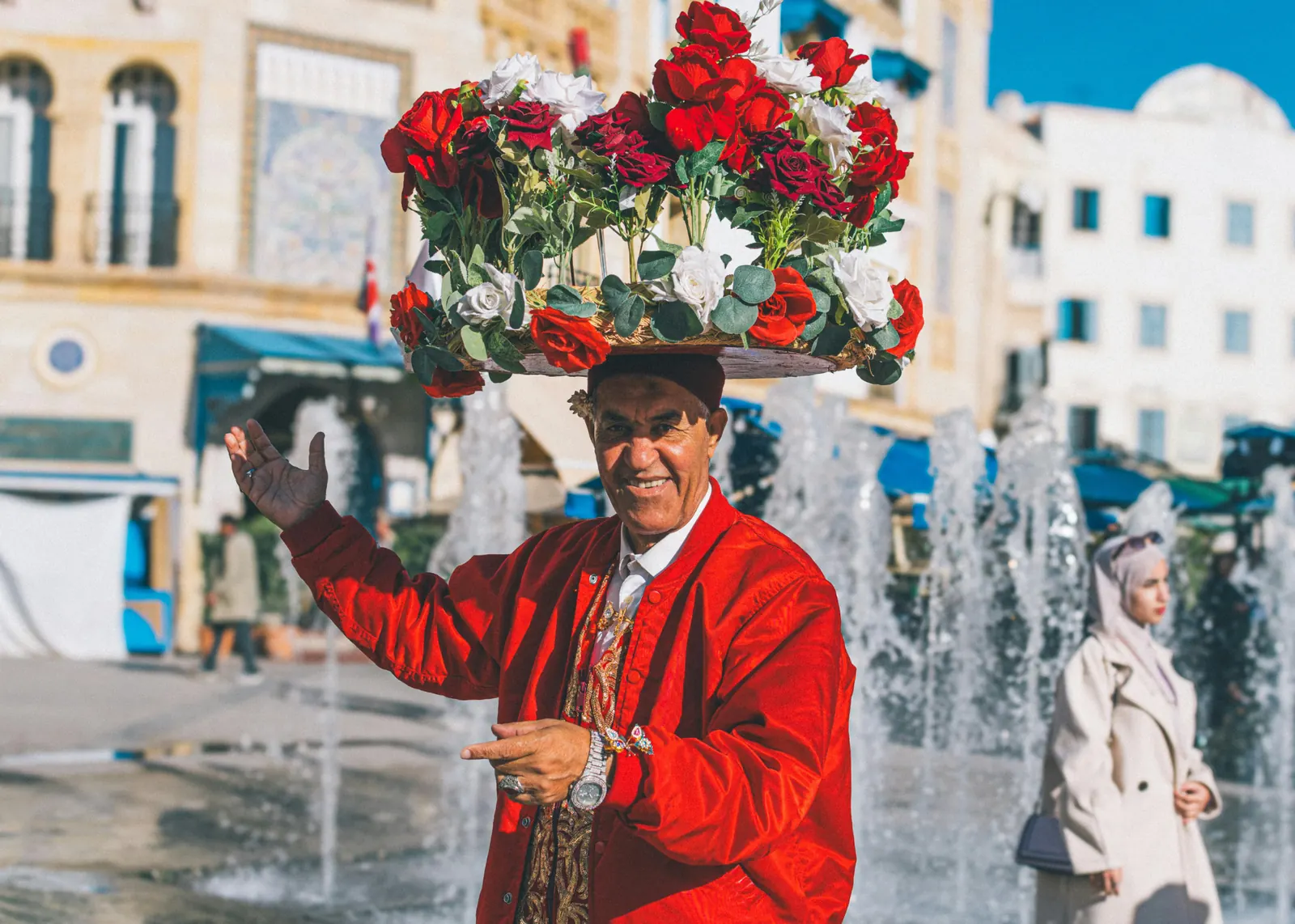
Tunisian street life
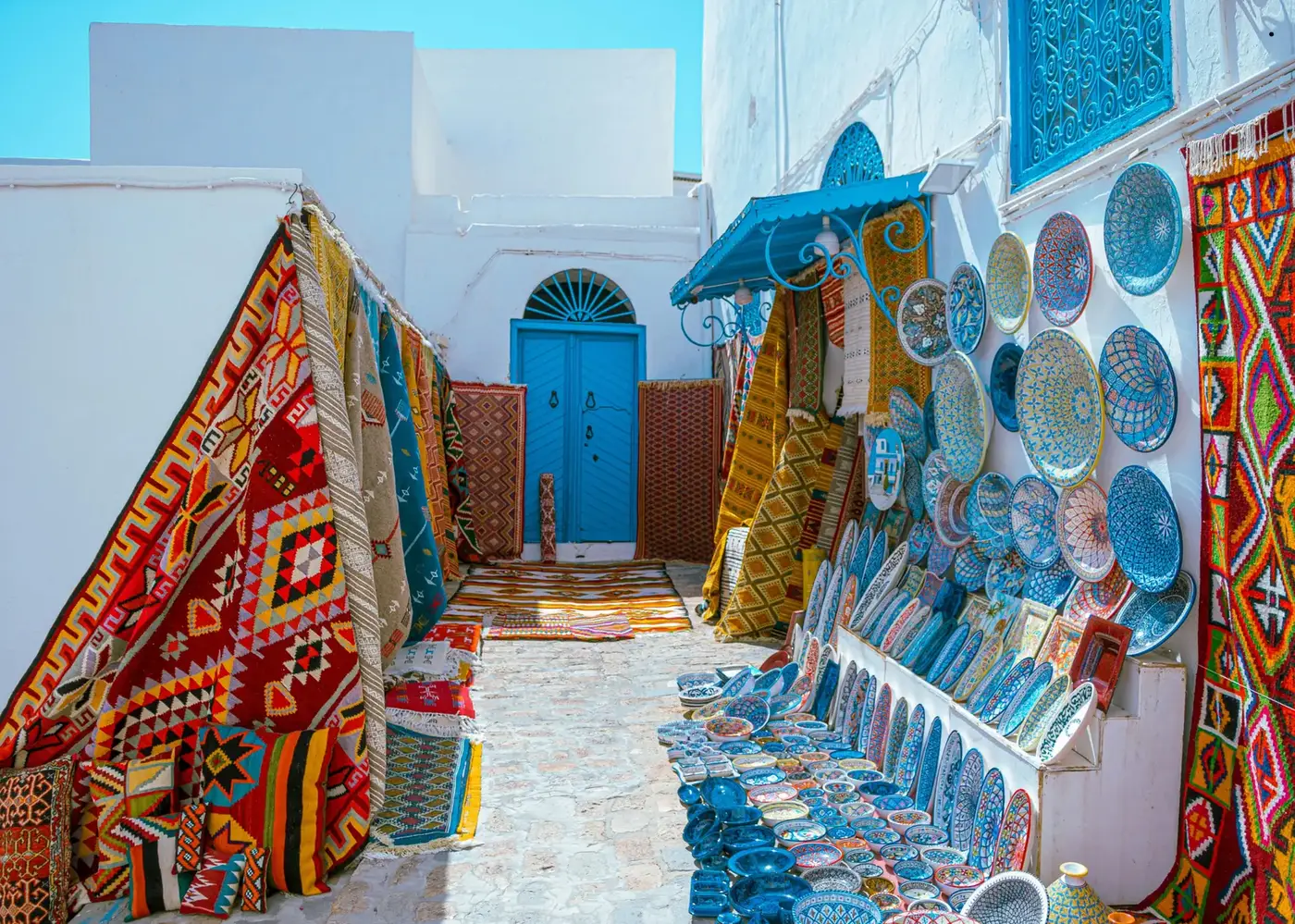
Painted Tunisian pottery in a medina alley

Crafts you can carry home

Tunisian craft traditions are alive in a way that's rare elsewhere in the Mediterranean — you can still buy directly from the family that has made the object for six generations. Look for: hand-knotted carpets and flatwoven mergoum kilims from Kairouan (graded by knot density and stamped by the national craft office); the green and yellow ceramics of Nabeul; the painted, signed pottery of Sejnane, made by Berber women with techniques unchanged since the Neolithic and inscribed by UNESCO in 2018; engraved copper trays and lanterns from Tunis; olive-wood kitchenware from the Sahel; chunky silver Berber jewellery from the south; and the southern leather slippers called balgha. For the kitchen, take home harissa in a tube, a tin of olive oil from a single estate (Olivko, Domaine Triki, Mahjoub), saffron from local cooperatives, and orange-blossom or rose water distilled in Nabeul each spring. A jar of artisanal harissa weighs nothing and will outclass anything you can buy at home. In the souks, prices are negotiable — half the asking price is a fair starting point, and a smile, a glass of mint tea, and patience get you further than aggressive haggling.

Music, hammams and the rhythm of daily life

Tunisia has one of the most layered music scenes in the Arab world. The classical malouf, brought from Andalusia and codified in the 1930s by the Rashidiyya ensemble, is still taught in conservatories and performed in concert halls. Sufi stambeli, with roots in sub-Saharan Africa, uses iron castanets and a three-stringed gumbri to induce trance during all-night ceremonies. Mezoued — bagpipe-driven, working-class, defiant — is the sound of weddings and football victories. And Tunis has a serious electronic and jazz scene; the Carthage International Festival, held every July in the 1,800-year-old Roman theatre, has hosted everyone from B.B. King to Ibrahim Maalouf. The hammam is the other ritual every visitor should try at least once. A steam bath, a vigorous scrub with a kessa glove, a lather with savon noir made from black olives, mint tea afterwards on a tiled bench — you emerge half a kilo lighter and entirely recalibrated. Look for one attached to a restored medina house (Dar el-Jeld in Tunis, the hammams of Sidi Bou Said) for the most atmospheric experience. Daily rhythms: long lunches, late dinners that start at 9, espresso strong enough to require footnotes, evenings on terraces, the call to prayer five times a day rolling across the rooftops, mint tea poured from arm's length to make foam. Tunisia is not in a hurry. Your trip will be better if you aren't either.
Daily life in a Tunisian medina
Modern Tunisia

Modern Tunisia: independence, the Arab Spring and a Nobel Peace Prize

Tunisia became independent from France in 1956 under Habib Bourguiba, a French-trained lawyer with a radical agenda. Within a decade he had abolished polygamy, granted women the vote and the right to divorce, made primary schooling compulsory and free for both sexes, and built one of the most developed education systems in the Arab world. Tunisian women today have legal rights — to work, to inherit, to marry whom they choose, to lead a government — that are still contested in much of the region. In December 2010, a young fruit seller in the inland town of Sidi Bouzid set himself on fire in protest at police harassment. Within weeks, mass demonstrations forced the country's authoritarian president into exile. The Tunisian Revolution lit the fuse for the Arab Spring across the entire Middle East. Of all the countries that rose, Tunisia is the only one that produced a working democracy: a new constitution in 2014, peaceful transfers of power, an active press, and a quartet of civil-society organisations (the trade union, the employers' federation, the human rights league and the lawyers' order) who won the 2015 Nobel Peace Prize for keeping the transition on track. This is the country you arrive in: ancient, layered, sometimes turbulent, deeply hospitable, intellectually serious, and quietly proud of being unlike anywhere else.
Blue door in Sidi Bou Said
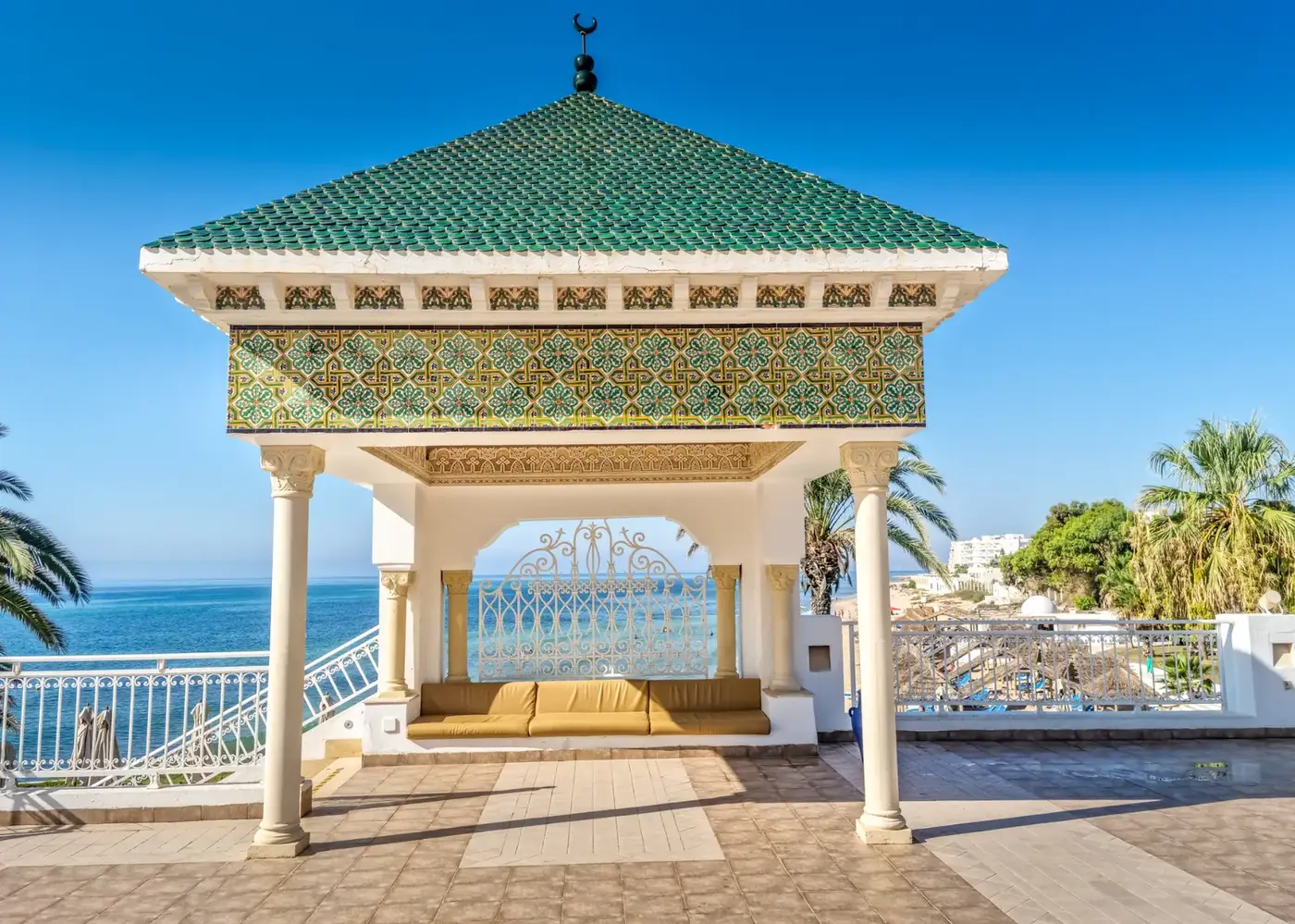
Cliff pavilion in Sidi Bou Said
Souk lane
Pottery shop

Ready to plan your Tunisia trip?

Build a custom 3, 7 or 14-day itinerary in 60 seconds with our AI Trip Planner.